
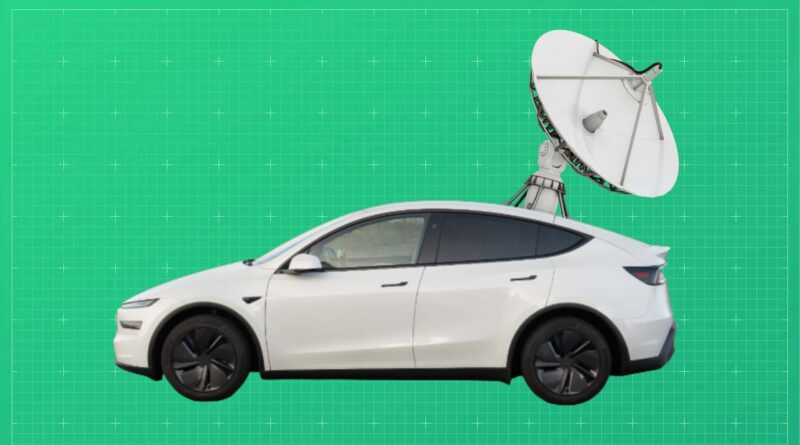
The Real Gamechanger: This one obvious feature could put Tesla back on top. Here is a time when it can happen
- Tesla has filed a patent that suggests it can put Starlink satellite internet receivers in its cars.
- Having quality broadband anywhere in the world would be a big and obvious advantage for the company.
- It will help create electric cars not only as car replacements, but also as mobile power plants and workstations.
Tesla may be preparing to add Starlink to its cars, according to a patent application it first announced Electrek. The connection is so predictable that it has been rumored for years; Tesla CEO Elon Musk also runs SpaceX, the company that makes Starlink.
The service’s high-speed internet would certainly benefit Tesla customers and might be a big enough upgrade to lure me into the Tesla camp. Here’s why.
What we know
Tesla has filed a patent for a vehicle roof assembly that is transparent to radio frequencies, specifically to allow satellite communications to pass through. This is important because signals from SpaceX satellites cannot reliably penetrate glass or metal.
The patent doesn’t describe what capability this will enable or why Tesla is pursuing it, but it’s fairly easy to read between the lines here. Teslas already have GPS receivers and use internet streaming to access satellite radio. The only other use case for a satellite connection in a car would be some sort of communications or internet system, and since Musk also runs SpaceX, it seems obvious that the link would work. It certainly wouldn’t be the first time Musk has used his position as CEO of one of his companies to win lucrative contracts for another.
We still don’t know when or if this will come to Tesla vehicles, but the patent filing is our best sign so far that it’s coming. Tesla also tends to deploy new technology fairly quickly, so it might not take too long.
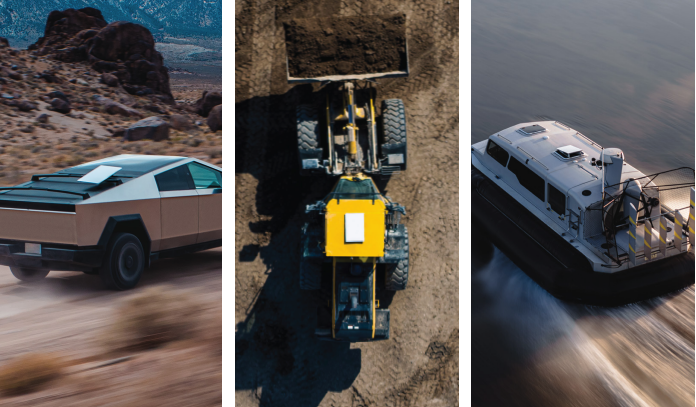
SpaceX is already showing Cybertrucks in official materials promoting Starlink’s “Performance Kit.” Direct integration would be the obvious next step and would address any durability concerns.
Photo credit: InsideEVs
Why Starlink in Tesla is a fantastic idea
I think that would be a big win for Tesla customers and ultimately the industry as a whole. Most of the speculation on the matter has focused on autonomy, as fans have speculated that it might allow for some sort of connectivity between cars or active updating in dead zones. This may be true, but it remains unproven. Sending a signal to a satellite and back to Earth is probably not going to be the most reliable or fastest way for two cars at the same intersection to communicate. I’m open to being wrong there, but the added value is uncertain.
The real advantage is obvious: Internet, anywhere. Starlink is remarkably reliable and covers essentially the entire globe with minimal latency and great speed. This means that all of your app’s controls – from remote climate control and unlocking to Dog Mode and Sentry monitoring – can work anywhere.
More importantly, if Tesla allows you to use the Starlink signal as a mobile hotspot, you’ll be able to share that data with any device. That’s a big deal—Tesla is one of the few companies that won’t let you use their vehicles as a mobile hotspot—but the payoff could be huge. Teslas already have a cool “Camp Mode” that lets you use the air conditioning, watch movies, charge electronics and use lights without worrying about your 12-volt battery. Add an internet connection and you have a fully functional remote office and sleeping area, accessible anywhere in the world within a few hundred miles of a power outlet.
This would be especially beneficial for a Cybertruck that has the tires and clearance to get deep into a rut, and the ability to export the power you need to run a mobile office.
Of course, this yin has a natural yang: Internet anywhere means you can be reached from anywhere. That means a camping trip is no longer an excuse to not check your email. But I think the reward would be worth it. Knowing that you can call emergency services, solve problems using the Internet, and communicate with loved ones makes the wilderness much more accessible and safe for the average person.
A true innovation
This would be a great time for Tesla to launch Internet Access Anywhere, as the company is otherwise starved for new innovations. The improvements in “Full Self-Driving (Supervised)” are undeniably impressive, but if you’re a Tesla fan and want to drive your own car, the company has done little to move the needle in recent years.
The Cybertruck’s 800-volt architecture, V2G support, and four-wheel steering may have been new to Tesla, but other automakers have offered these benefits for years. Its steer-by-wire and 48-volt system were indeed new, but it’s hard to say there was much benefit to the customer. The Model 3 and Model Y have also been updated in recent years, but these were quality-of-life improvements, not major breakthroughs. That’s why the Model Y didn’t quite get our flagship this year.
This company built their empire on blowing us away. He has to do it again to fix his dirty slump. With the Roadster constantly running late, the Cybertruck crashing, the base models obsolete, and the Robotaxi still unresolved, the Starlink ability is a new addition the company could make today, not years in the future. It would be exactly the kind of innovative feature that the competition couldn’t match.
Perhaps more importantly, it would be the first company to discover what the future of electric cars looks like: Power, connectivity and convenience anywhere. Your electric car won’t just be a car replacement, it’ll be a roving base camp that will power, plug in or haul everything you need to live. It’s such a compelling vision that I’m sure competitors would quickly follow suit and potentially pay Starlink to connect their own cars if there are no comparable alternatives.
That future seems possible, someone just has to lead us there. Again, it looks like it could be a Tesla.
Contact the author: Mack.hogan@insideevs.com