
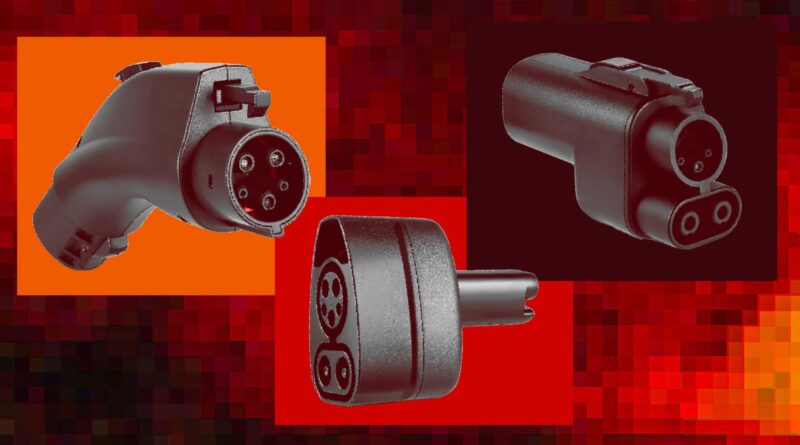
EV guide for Peklo charging adapter owners
There is never a dull day in the automotive industry. Two years ago, Ford CEO Jim Farley shocked the world by announcing that the automaker’s battery-powered cars would be the first non-Tesla electric vehicles to gain access to the Tesla Supercharger network.
Fast forward to the end of 2025, and Ford—the company that started the radical transformation of America’s EV charging—has dramatically scaled back its EV ambitions.
However, other car companies, as well as many charging station operators, have already taken this path, so there is no going back now. As a result, we are now knee-deep in a transitional phase that will likely last for years to come, forcing EV owners to be aware of charging adapters.
Not only that, but all EV owners in North America should have at least one charging adapter in their cars at all times. Because charging stations are constantly being upgraded, you never know when you’ll find yourself with a dead battery, a fully functional charger close at hand, and an outlet that won’t fit.
But don’t worry, we’ve got your back with a comprehensive guide to electric car chargers that should help everyone wrap their heads around the weird and wonderful world we live in right now.
What charging adapter do I need for my EV?
The first thing is to know what type of charging port is on the car. Based on this, we can then determine which adapters are needed for each charging situation. In North America, electric cars and plug-in hybrids have four charging connectors, but two of them are the de facto standard for most battery cars sold today.
CCS1 (Combined Charging System 1): DC fast charging or AC charging/Level 1, Level 2
This has been the default choice for American automakers for the longest time, so it can be found on the vast majority of non-Tesla EVs and PHEVs sold stateside. The two large pins at the bottom are for DC fast charging, while the round part at the top, called the J1772 port, handles AC charging and communication between the charger and the vehicle.
If your car has this type of charging port, you will need two charging adapters. You will need to use a NACS to CCS1 adapter when trying to charge with a Tesla Supercharger or other DC fast chargers that have a Tesla-style NACS cable.
If you are in a hotel, garage, or other location that has a Tesla level 2 target charger, you will need a NACS to J1772 charging adapter. NACS plugs look the same for both DC and AC chargers, but the charging adapters are different.
If you want to use a charger that has a CCS1 or J1772 cable, then you can do without an adapter. Since J1772 sockets are pretty common these days, if you only carry one adapter, it should be a NACS to CCS1 key.
J1772: AC Charging Only (Level 1 or Level 2)
This type of adapter is part of the CCS1 connector. However, some cars, such as most plug-in hybrids and older electric cars, cannot be fast-charged, so they only have a slow-charge port.
If your car has a J1772 charging port and you want to charge from a Tesla target charger or other AC charger that has a NACS cable, you will need a NACS to J1772 adapter. The J1772 port cannot be used for DC fast charging, so if you have a NACS to CCS1 adapter it will not work. This type of port also cannot be used with Tesla Superchargers.
NACS (north American Charging Standard): DC fast charging or AC charging (level 1, level 2)
All modern Tesla EVs sold in the United States and Canada are equipped with this type of connector invented by Tesla. It is also the connector of choice on all Tesla Superchargers in North America.
This means that more and more older car manufacturers are installing NACS charging ports in their EVs from the factory, meaning the number of cars that could need a charging adapter is growing every day. Some of the non-Tesla EVs that have a Tesla-style charging port are the 2026 Rivian R1S and R1T, 2026 Nissan Leaf, 2026 Cadillac Optiq, 2025 Hyundai Ioniq 5, 2026 Hyundai Ioniq 9, and 2025 Lucid Gravity.
If your car has a NACS charging port, you can use any Tesla Supercharger, Tesla Destination Charger, or any other NACS-equipped charger without an adapter. If you want to charge on a CCS1-equipped DC fast charger—like most existing Electrify America and EVGo stands—you’ll need a CCS1 to NACS adapter. If you want to charge on a J1772 Level 2 charger, you will need a NACS to J1772 adapter.
CHAdeMO: DC fast charging
This was the original fast charging standard, but is now nearing obsolescence in North America as automakers have switched to CCS1 or NACS. That said, there were still a few EVs and PHEVs that have the CHAdeMO connector, including the first two generations of the Nissan Leaf and the Mitsubishi Outlander PHEV. But this standard is fast disappearing.
The good news is that there are some CCS1 to CHAdeMO adapters for fast charging, making it much easier to use CHAdeMO equipped cars in the modern world. Bad news? These adapters are more expensive than all the others listed here and are not officially recognized by any car company or CHAdeMO association.
So while there are options, owners should use this type of adapter at their own risk. It’s also worth noting that the CHAdeMO port cannot be used for Level 1 or Level 2 charging.
Where can I buy the right charging adapters for my electric car?
In general, almost all car manufacturers sell manufacturer-approved charging adapters. You can find them on their official website or at your local retailer. Third-party adapters are also widely available, but keep in mind that they are not approved by the manufacturers. In addition, some cheap adapters are downright dangerous.
Does it affect my car warranty if I use a charging adapter?
Generally speaking, no. However, it is important to note that the warranty may be voided if a third-party adapter is used and something goes wrong during charging. To avoid this, it’s best to use manufacturer-approved adapters sold by the automakers themselves online or at dealerships.
BMW is currently the only car manufacturer that recommends using a third-party locking adapter from Lectron, which also makes adapters for other car manufacturers.
Lectron, A2Z, and Amphenol sell UL2252 certified adapters, so if you can’t get your hands on an adapter sold directly by the car manufacturer, a third-party safety-certified adapter is your best bet, as long as you’re mindful of warranty limitations.
A solid adapter will cost you around $200. But that’s a small price to pay for peace of mind.