
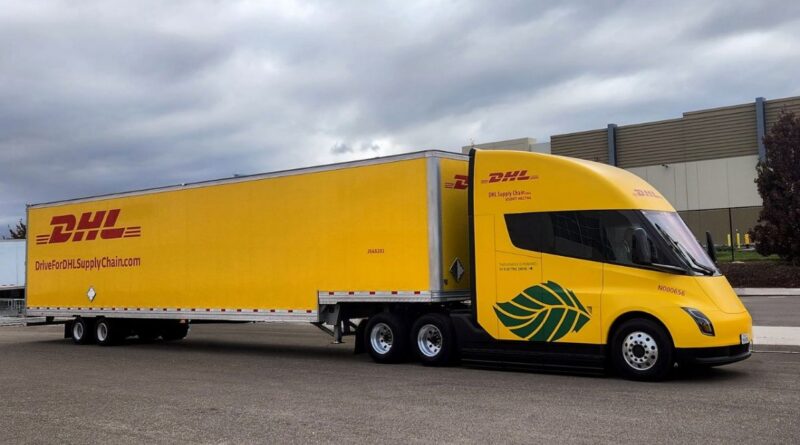
The logistics giant takes delivery of the first Tesla Semi with an impressive 1 kWh/km consumption
Tesla is best known for its electric passenger cars, but it is also working on launching one of its most impressive products to reduce traffic emissions, in the form of the Tesla Semi electric truck.
So far, the Semi has a limited number of customers as Tesla works to bring it to the heavy trucking and logistics industry around the world.
Now DHL, a global logistics leader, has taken delivery of its first Semi and conducted a two-week trial run covering nearly 5,000km with some impressive results.
This news was shared by the Tesla and EV news account run by Sawyer Merritt after it was originally reported American Journal of Transportation.
The semitrial was supposed to drive the trucks at an average speed of 80 km/h. At these speeds, the truck averaged 1 kWh/km, making it one of the most efficient in its class.
Full-load tests were also carried out, with one test showing the Semi traveling 628 km with a load of 34 tonnes.
Jim Monkmeyer, president of transportation, DHL Supply Chain North America, said the pilot exceeded expectations and demonstrated its ability to efficiently transport a typical DHL shipment over long distances on a single charge.
“Integrating the Tesla Semi into our fleet is an important step towards achieving our decarbonisation goals and providing more sustainable solutions for our customers,” he said.
“With a range of up to 500 miles, the Semi unlocks opportunities previously beyond the limits of heavy-duty electric vehicles, and we’re excited to work with Tesla to make that a reality.”
DHL plans to add more Semis to its US fleet, which will help the company reduce emissions in the coming years as a road logistics operator.
The first deliveries of the Tesla Semi began as part of a trial run with a major food and beverage customer, PepsiCo, in the US as early as 2022.
After taking delivery of the Tesla Semi, PepsiCo announced in May 2024 that it had taken new delivery of the all-electric truck, doubling its fleet to 50 operating from a manufacturing and distribution facility in California.
In recent months, the company introduced an updated Semi design with several high-end upgrades. This included improved range and charging specifications.

The updated Semi also has improved aerodynamics for better efficiency and increased payload capacity, along with charging upgrades.
It can now provide a range of over 800 km and an 800 kW powertrain with an energy consumption of just 1.06 kWh/km. This is very much in line with the consumption figures that DHL recorded in the trial run after taking delivery of the Semi.
For charging, 1.2MW ultra-fast charging will be on offer, and the Semi will be able to use Tesla’s supercharging hardware to achieve these speeds.
Another area the Tesla team shared is preparing the Semi for autonomous operation and zero-emission long-haul trucking.
It will likely use the company’s proprietary Fully Autonomous Driving (FSD) technology, which can be seen on its Robotaxi fleet and the upcoming Cybercab.
This would help operators of these trucks, such as DHL, to potentially have access to some of the most advanced truck fleets, reducing driver stress and fatigue.
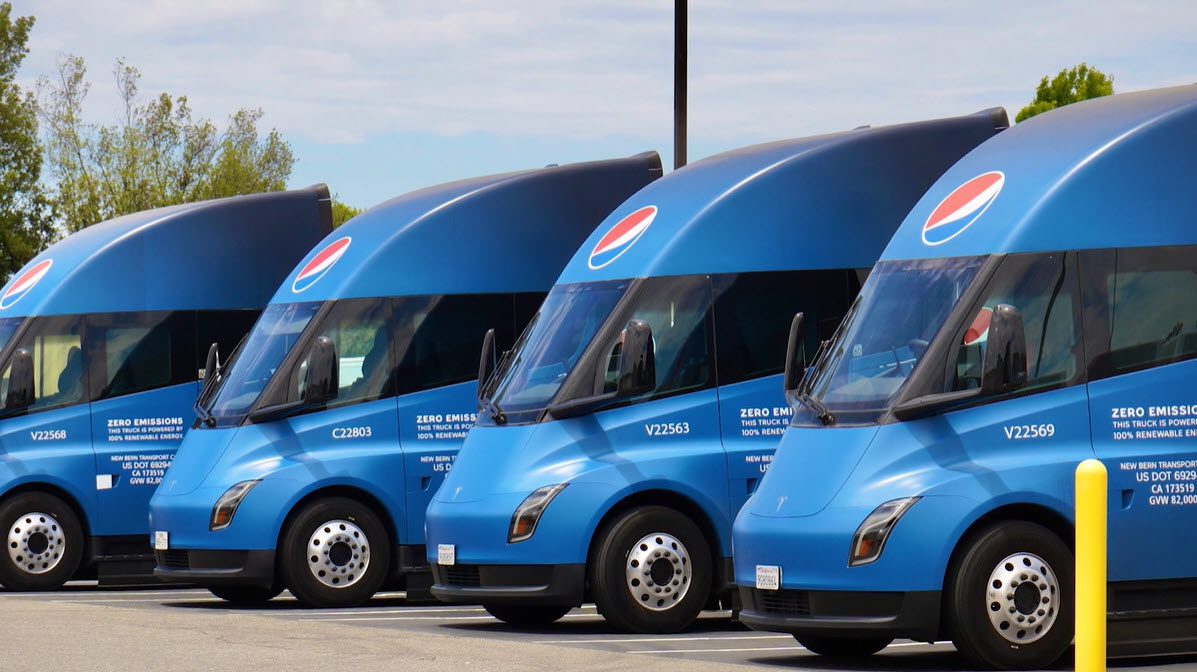
Over the past few years, the Tesla Semi has been observed being used by Walmart, retail giant Costco, and other operators.
We look forward to seeing more real-world use of the Semi in the coming months, before the facelifted Semi goes into production expected in 2026.

Riz is the founder of Melbourne-based carloop, which specializes in Australian EV data, insights and trends. He is a mechanical engineer who spent the first 7 years of his career building transportation infrastructure before starting carloop. He has a passion for cars, especially EVs, and wants to help reduce transport emissions in Australia. He currently drives a red Tesla Model 3.